Hot Air / Stirling Engine Workshop
About the Stirling Engine Workshop
The Hot Air / Stirling Engine Workshop is a fully practical, hands-on training designed
to teach participants how Stirling engines work, how heat converts into mechanical motion, and how to
assemble and operate a complete functional Stirling engine model.
This workshop is ideal for engineering students, science enthusiasts, makers, and anyone interested in
classical thermodynamics and mechanical innovation. By the end of the workshop, every participant will
assemble, test, and operate a real Stirling engine while understanding its working principles.
🧩 Workshop Modules – Stirling Engine Workshop
📘 Thermodynamics & Operating Principles
Learn the complete theory behind Stirling engines, including hot-air expansion, cooling contraction, pressure cycles, displacer-piston coordination, and heat–mechanical energy conversion. Concepts are explained practically with real working models.
🔧 Hands-On Engine Assembly
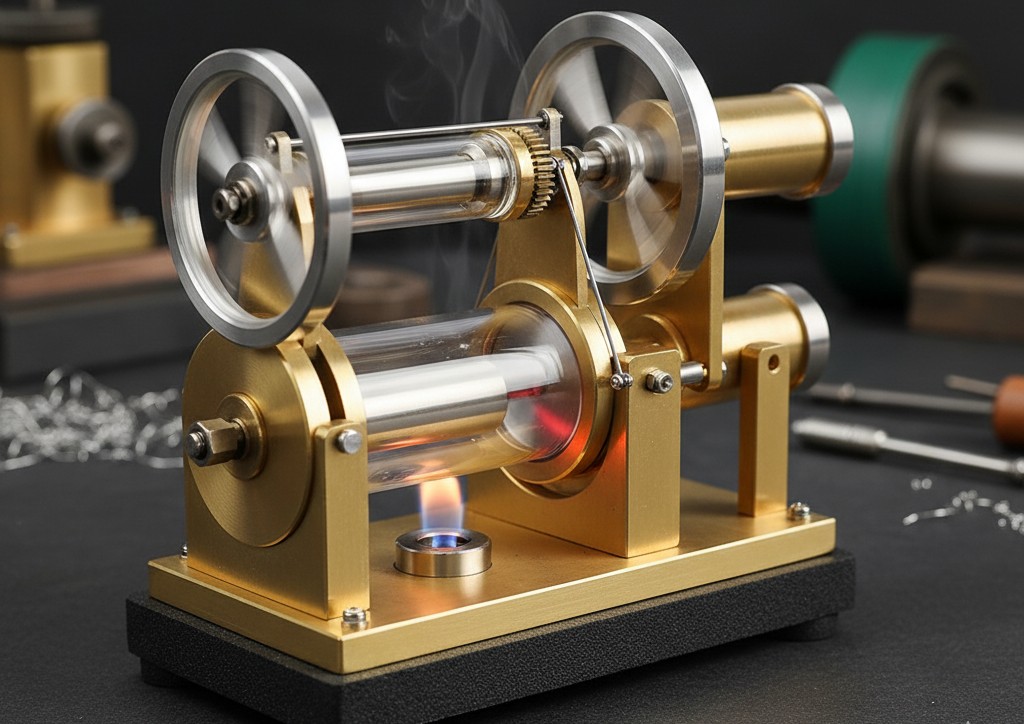
Assemble a Stirling engine from scratch: frame setup, flywheel installation, crankshaft linkage, piston alignment, heating chamber placement, lubrication, and precision balancing for smooth motion.
🧪 Testing & Performance Tuning
Learn heating techniques, flame control, rotational testing, RPM improvement, friction reduction, air leakage checks, and efficiency optimization to achieve smooth and stable engine operation.
🔥 Safe Operation & Handling
Understand how to safely operate Stirling engines, manage heating sources, prevent overheating, maintain spacing, and practice correct startup and shutdown procedures.
⏳ Workshop Duration
The workshop typically spans 3 to 4 days, covering:
Day-1: Thermodynamics & basic theory
Day-2: Engine assembly
Day-3: Assembly & Testing
Day-4: Advanced concepts
📘 What You Will Learn in the Stirling Engine Workshop
🔥 Thermodynamics & Heat Cycles
Understand how heat is converted into mechanical motion, Stirling cycle working, expansion–compression phases, temperature gradients, energy transfer, and efficiency concepts.
⚙️ Mechanical Assembly & Alignment
Learn how to assemble key components such as flywheel, crankshaft, piston, displacer cylinder, connecting rods, bearings, and support structures with proper alignment and lubrication.
🔥 Heat Source Management
Study safe heating techniques, flame control, temperature handling, and maintaining optimal heat input to achieve smooth and continuous engine rotation.
🔩 Materials & Thermal Behavior
Learn why specific metals and components are used, how thermal expansion affects motion, and how to avoid heat stress or deformation in engine parts.
🛠 Engine Assembly & Fine-Tuning
Assemble the full Stirling engine, check tolerances, remove friction points, ensure airtightness, balance the flywheel, and tune the mechanism for maximum RPM.
🚀 Hands-On Engine Testing
Test engine startup, rotational smoothness, vibration control, heat-to-motion efficiency, and performance tuning under various temperature conditions.
🎯 Key Skills You Will Gain in the Stirling Engine Workshop
🔧 Hands-On Stirling Engine Assembly
Learn to assemble a complete Stirling engine—displacer cylinder, piston, crankshaft, flywheel, linkage rods, and frame structure with precision.
📘 Strong Understanding of Thermodynamics
Gain deep knowledge of heat cycles, pressure changes, expansion–compression, and how thermal energy converts into mechanical rotation.
🔥 Heat Input & Engine Operation
Learn how to safely apply heat, optimize temperature differences, start the engine smoothly, and maintain continuous operation.
⚙️ Engine Calibration & Balancing
Fine-tune piston motion, reduce friction, adjust tolerances, balance the flywheel, and achieve maximum mechanical efficiency.
🛠 Mechanical Motion & Linkage Mechanics
Understand how crank mechanisms, push-rods, bearings, and rotational systems work together to produce smooth cyclic motion.
🔍 Troubleshooting & Optimization
Identify thermal leaks, friction points, misalignment, air-tightness issues, and improve RPM through systematic tuning.
👥 Who Can Join the Stirling Engine Workshop?
🎓 Students
Ideal for school and college students interested in classical thermodynamics, mechanical systems, and hands-on engineering.
🛠 Hobbyists & Makers
Perfect for DIY enthusiasts who enjoy building mechanical models, experimenting with heat engines, and understanding how motion is generated.
🏫 Engineering Colleges
Highly suitable for Mechanical, Automobile, EEE, Mechatronics, and Aerospace departments focusing on practical engine mechanisms.
🤝 Technical Clubs & Innovation Cells
Great for mechanical clubs, project labs, innovation cells, and engineering forums looking for a practical working model build.
🔥 Engine & Thermodynamics Enthusiasts
Anyone curious about heat engines, Stirling mechanisms, or classical power-generation concepts can join and learn deeply.
🌟 Benefits of the Stirling Engine Workshop
🔥 Build a Working Stirling Engine
Every participant assembles, aligns, and tests a fully functioning Stirling engine that runs using heat-to-motion conversion principles.
👐 Complete Hands-On Experience
Learn by assembling mechanical parts, setting piston alignment, installing flywheels, and tuning the engine for smooth motion — 100% practical.
🛠 Mechanical Tools & Real Components
Work with precision tools, metal components, crankshaft systems, pistons, bearings, and heat chambers just like real mechanical engineering labs use.
📜 Certification of Completion
Receive an official workshop certificate from MMTimes, adding strong value to your resume, academic profile, or engineering portfolio.
💡 Thermodynamics & Innovation Insight
Gain a deep understanding of external combustion engines, heat transfer, energy cycles, efficiency concepts, and real-world engineering applications.
🤝 Team Collaboration Experience
Build and troubleshoot in teams, improving coordination, mechanical problem-solving, and hands-on engineering teamwork.
🚀 Future Scope — Stirling Engine Workshop
⚙️ Mechanical Engineering Pathways
Build strong foundations in mechanisms, heat engines, and machine design—skills helpful for careers in mechanical R&D, engine design, and thermal systems engineering.
🔥 Thermal & Energy Research
Explore opportunities in thermodynamic research, alternative energy systems, external-combustion engine studies, and renewable heat-to-power technologies.
🏭 Industrial Automation
Apply concepts of motion conversion, mechanical balancing, pistons, and linkages to industrial automation, machine design, and precision engineering.
♻️ Sustainable Energy Devices
Work on clean-energy projects using solar-heated Stirling engines, low-emission power systems, and experimental eco-friendly heat engines.
🔬 Scientific Prototyping
Gain confidence to build mechanical prototypes, perform thermal experiments, and design engines for educational or scientific demonstrations.
👨🏫 Teaching & Academic Opportunities
Use Stirling engines for classroom demonstrations, STEM education, lab activities, or mechanical project guidance as a teacher, mentor, or workshop leader.
💼 Startup & Maker Projects
Build miniature engines, DIY engineering kits, desk-toy engines, or custom mechanical devices as part of a product line or maker startup.
🔥 Ready to Build Your Own Stirling Engine?
Join the hands-on Stirling Engine Workshop and learn how to convert heat into motion by building and testing your own working external-combustion engine.